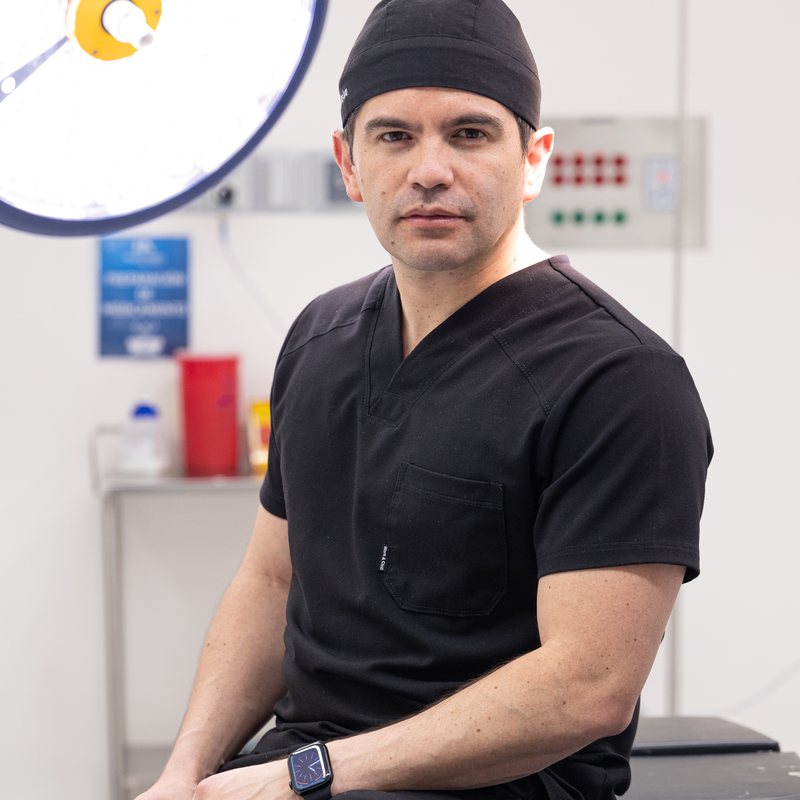
Dr. Luciano Ríos Lara
- Board certified by the Mexican Board of Plastic Surgery
- Trained at UNAM and Hospital General de México
- Teaches plastic surgery residents
Facial and neck surgery · CDMX
A nose in harmony with your face that looks natural and looks like you.
Rhinoplasty in Mexico City is surgery that reshapes the nose, changing its size, tip, bridge or nostrils, and can also improve breathing problems such as a deviated septum.

Results
Real patients of Dr. Ríos Lara, published with their consent.
“A real patient testimonial will go here, with a verified name or initials.”
Your safety
Your surgery takes place at Hospital Ángeles Clínica Londres in Roma Norte, Mexico City, under national and international safety protocols. The facility is also cardio-protected.
The doctor provides all the care you need with no additional surgeon's fees. Only extra hospital costs, if any, are covered by you.
Is it for me?
Rhinoplasty, often called a nose job, reshapes the bone and cartilage of the nose so it fits the rest of your face. It can make the nose smaller or larger, refine the tip, smooth a hump on the bridge, narrow the nostrils or adjust the angle between the nose and upper lip.
It is not only cosmetic. The same operation is used to correct congenital differences, the aftermath of a broken nose and some breathing problems, such as a deviated septum. When the septum is corrected at the same time, the procedure is often called a septorhinoplasty.
There are two general approaches. Closed rhinoplasty uses incisions inside the nose; open rhinoplasty adds a small incision across the columella, the strip of skin between the nostrils. Your surgeon recommends one based on your anatomy and the changes you want.
Results appear gradually. The most visible swelling settles within the first few weeks, but fine definition, especially at the tip, can take months.
Rhinoplasty is for people whose facial growth is complete and who want to change something specific about their nose: a dorsal hump, a wide or drooping tip, asymmetry, or a nose they feel is out of proportion. It is also an option when cosmetic concerns come with difficulty breathing through the nose.
At your consultation, bring a clear idea of what bothers you and what you hope to achieve. A good rhinoplasty aims for a nose that looks natural on your face, not a copy of someone else’s. Your surgeon will also examine the inside of your nose for breathing issues worth correcting at the same time, and explain what is realistic given your skin thickness and cartilage. If you have had nose surgery before, say so, since revision rhinoplasty is usually more complex. If you are traveling to Mexico City for surgery, plan your stay around the first follow-up visits, when the splint and sutures are usually removed.
Recovery
Congestion, moderate discomfort, swelling around the eyes and some bruising are normal. Rest with your head elevated and avoid alcohol.
The splint is typically removed after about a week. Many patients return to desk work within 5 to 10 days.
Bruising and swelling keep fading over several weeks. Strenuous activity and alcohol can usually resume around three weeks, as your surgeon advises.
Residual swelling, particularly at the tip, resolves slowly. The final shape typically becomes clear over several months.
Common questions
Rhinoplasty takes 1 hour or longer, depending on your case. It is done under general anesthesia or local anesthesia with sedation, and it usually requires a hospital stay.
You are under general anesthesia or local anesthesia with sedation during surgery. In the first few days, congestion and moderate discomfort are normal. You receive pain-control instructions when you are discharged.
Recovery takes about 3 weeks. The splint is typically removed after about a week, and many patients return to desk work within 5 to 10 days. Strenuous activity and alcohol can usually resume around three weeks, as your surgeon advises.
Closed rhinoplasty uses incisions inside the nose. Open rhinoplasty adds a small incision across the columella, the strip of skin between the nostrils. Your surgeon recommends one approach based on your anatomy and the changes you want.
Results are long-lasting to permanent. The most visible swelling settles within the first few weeks, but fine definition, especially at the tip, can take months.
Expected, temporary effects include congestion, swelling, bruising around the eyes and numbness of the nasal skin. Risks include bleeding, infection, thickened scars, blood clots and asymmetry or an incomplete result that may require revision surgery.
Pricing depends on your case and is confirmed at your consultation. At that visit, your surgeon evaluates your nose, your breathing and your goals, and explains what can realistically change.
It depends on how your recovery goes and on your follow-up visits, when the splint and sutures are usually removed. Your surgeon will define the length of your stay with you at your consultation.
Price
Price range to be confirmed
Your final price depends on your case. You'll get it in writing at your consultation, with everything it includes.
Get my quotePhone: 55 6232 9139
Getting here
Google Maps (opens in a new tab)Waze (opens in a new tab)Apple Maps (opens in a new tab)View location
Your next step