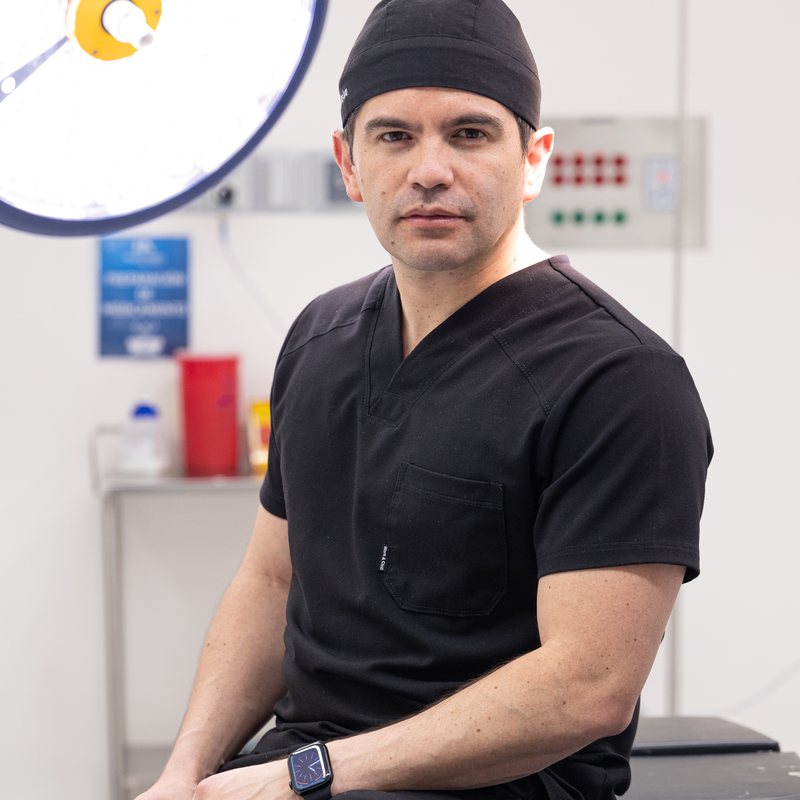
Dr. Luciano Ríos Lara
- Board certified by the Mexican Board of Plastic Surgery
- Trained at UNAM and Hospital General de México
- Teaches plastic surgery residents
Breast surgery · CDMX
Restoring the shape of your breast and reconnecting with your body, at your own pace.
Breast reconstruction is surgery that rebuilds the shape and volume of the breast after a mastectomy or injury, using implants or tissue expanders, or tissue from your own body. It is offered in Mexico City.

Results
Real patients of Dr. Ríos Lara, published with their consent.
“A real patient testimonial will go here, with a verified name or initials.”
Your safety
Your surgery takes place at Hospital Ángeles Clínica Londres in Roma Norte, Mexico City, under national and international safety protocols. The facility is also cardio-protected.
The doctor provides all the care you need with no additional surgeon's fees. Only extra hospital costs, if any, are covered by you.
Is it for me?
Breast reconstruction restores the shape of a breast that has been fully or partly removed, most often as part of breast cancer treatment. It does not change your cancer treatment or prognosis; its purpose is to rebuild the chest contour and help you regain symmetry and confidence in your body.
There are two main approaches. Implant-based reconstruction is often done in stages: a tissue expander is placed first and gradually filled to stretch the skin, then it is swapped for a permanent implant; in some cases the implant goes in directly. Autologous (flap) reconstruction uses skin, fat and sometimes muscle from another part of your body, such as the abdomen or back, to create the new breast.
Reconstruction can be immediate, during the same operation as the mastectomy, or delayed, months or years later. It is often completed with smaller follow-up procedures: nipple and areola reconstruction, fat grafting to refine the contour, or surgery on the other breast to improve symmetry. The right option depends on your cancer treatment, anatomy, health and preferences, and is decided together with your medical team.
Several factors weigh heavily on which technique fits best. Radiation therapy, for example, changes skin quality and can make implant-based reconstruction more prone to complications, so in those cases your own tissue is sometimes preferred or the timing of surgery is adjusted. The amount of tissue available on the abdomen or back, your body type and the size of the other breast also matter.
Breast reconstruction is for women who have had or will have a mastectomy, whether total or partial, and for those with a breast deformity from an injury or a congenital condition.
It is never mandatory and there is no deadline: some patients choose it right away, others years later, and others decide not to reconstruct. What matters is making the choice with complete information, together with your oncologist and your plastic surgeon.
Recovery
Discomfort, swelling and, in many cases, temporary drains are common. Hospital stay depends on the technique and is usually longer with flap reconstruction.
Your surgeon will tell you when to resume activities and how to care for your incisions and, if applicable, the area where tissue was taken.
If reconstruction is staged, the next surgeries are scheduled once tissues have healed and in coordination with treatments such as chemotherapy or radiation.
The shape settles over time. Implants may need revision in the future, and the reconstructed breast will continue to change with age and weight.
Common questions
Reconstruction can be immediate, during the same operation as the mastectomy, or delayed, months or years later. It is never mandatory and there is no deadline, and the decision is made together with your oncologist and your plastic surgeon.
There are two main approaches: implant-based reconstruction, often done in stages with a tissue expander, and autologous (flap) reconstruction, which uses skin, fat and sometimes muscle from another part of your body. The right option depends on your cancer treatment, anatomy, health and preferences.
Reconstruction may take more than one surgery. If an expander is used, it is later exchanged for a permanent implant, and the process is often completed with nipple and areola reconstruction, fat grafting or symmetry adjustments.
Discomfort, swelling and, in many cases, temporary drains are common in the first few days. Hospital stay depends on the technique and is usually longer with flap reconstruction. Your surgeon will tell you when to resume activities and how to care for your incisions.
Yes. Radiation therapy changes skin quality and can make implant-based reconstruction more prone to complications, so in those cases your own tissue is sometimes preferred or the timing of surgery is adjusted.
Risks include infection, bleeding, seroma and wound-healing problems, which are more common in smokers or after radiation. Implants can lead to capsular contracture, exposure or rupture, while flap reconstruction carries a risk of partial or total flap loss and discomfort at the donor site.
Pricing depends on your case and is confirmed at your consultation. That visit reviews your diagnosis and cancer treatment so the technique can be chosen together with your care team.
It depends on how your recovery goes and on your follow-up visits with your surgeon. Your length of stay is planned at your consultation.
Price
Price range to be confirmed
Your final price depends on your case. You'll get it in writing at your consultation, with everything it includes.
Get my quotePhone: 55 6232 9139
Getting here
Google Maps (opens in a new tab)Waze (opens in a new tab)Apple Maps (opens in a new tab)View location
Your next step