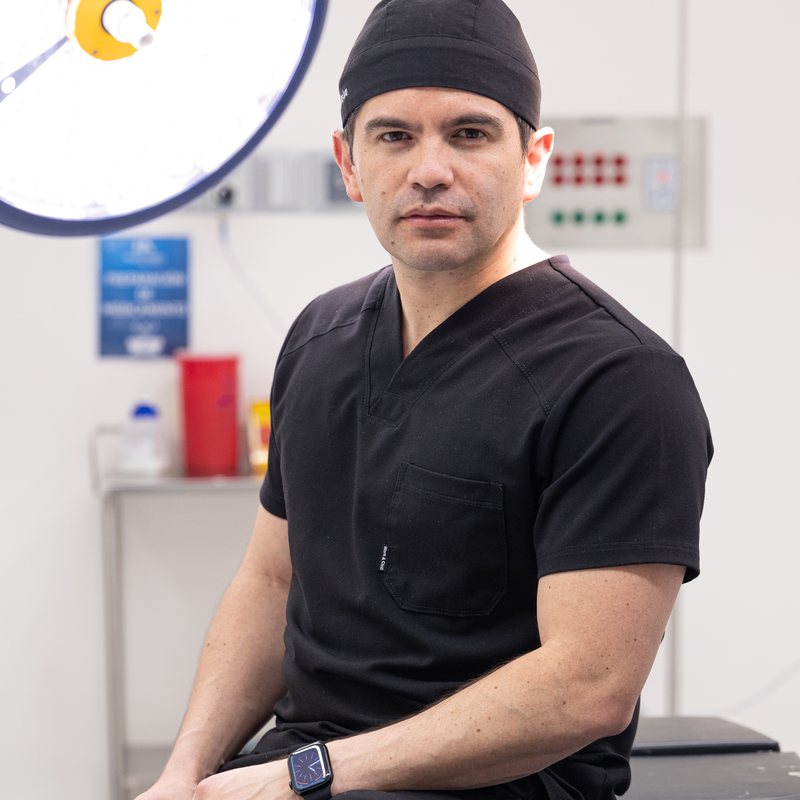
Dr. Luciano Ríos Lara
- Board certified by the Mexican Board of Plastic Surgery
- Trained at UNAM and Hospital General de México
- Teaches plastic surgery residents
Facial and neck surgery · CDMX
A balanced profile, with a chin that brings harmony and character to your face.
Chin surgery (genioplasty) in Mexico City reshapes the chin to balance the profile, either by placing a chin implant or by repositioning the chin bone forward, backward or to correct asymmetry.

Results
Real patients of Dr. Ríos Lara, published with their consent.
“A real patient testimonial will go here, with a verified name or initials.”
Your safety
Your surgery takes place at Hospital Ángeles Clínica Londres in Roma Norte, Mexico City, under national and international safety protocols. The facility is also cardio-protected.
The doctor provides all the care you need with no additional surgeon's fees. Only extra hospital costs, if any, are covered by you.
Is it for me?
The chin plays a big role in facial balance. A weak or recessed chin can make the nose look larger, the neck look shorter and the jawline look soft. A chin that is too prominent or off-center also throws off the profile. Chin surgery corrects these proportions.
There are two main approaches. The first is a chin implant, usually made of a solid biocompatible material and placed through a small incision under the chin or inside the mouth; it is mainly used to add projection. The second is a sliding (osseous) genioplasty: the chin bone is cut and moved forward, back, up or down, then held with small plates or screws. It allows movement in more directions and can correct asymmetry.
Chin surgery is often paired with rhinoplasty, since the nose and chin are seen together in profile, or with neck liposuction to sharpen the angle between the jaw and neck.
Choosing between an implant and a genioplasty depends on the type and amount of change you need. An implant is a shorter, simpler procedure, but it mainly adds projection. A genioplasty works on the bone and has a somewhat longer recovery, but it can reduce, lengthen, shorten or center the chin, using your own tissue. Either way, the goal is a balanced, natural profile, not a chin that draws attention.
It is an option if you feel your chin looks small, recessed, too long or off-center, and that it affects the balance of your profile. Your surgeon will look at your whole profile, including nose, lips and neck, to recommend an implant, a genioplasty, or to confirm whether the chin is truly the source of the imbalance.
If the main issue is your bite, meaning how your teeth come together, the evaluation should include an orthodontist or maxillofacial surgeon, because the right solution may be different.
Recovery
Swelling, bruising, soreness when chewing and numbness of the lower lip and chin are common. With an incision inside the mouth, a soft diet and rinses are usually recommended.
Visible swelling goes down and many people resume daily activities. Your surgeon will tell you when to return to work based on the technique used.
Intense exercise and contact sports are reintroduced gradually, typically after several weeks.
Residual swelling and sensitivity settle slowly, and the final contour becomes clear over several months.
Common questions
It depends on the type and amount of change you need. An implant is a shorter, simpler procedure, but it mainly adds projection. A genioplasty works on the bone and has a somewhat longer recovery, but it can reduce, lengthen, shorten or center the chin.
Depending on the technique, it is done under local anesthesia with sedation or general anesthesia. In the first few days, swelling, bruising, soreness when chewing and numbness of the lower lip and chin are common. You receive pain-control guidance when you are discharged.
Visible swelling goes down over the first weeks and many people resume daily activities. Your surgeon will tell you when to return to work based on the technique used. Intense exercise and contact sports are reintroduced gradually, and the final contour becomes clear over several months.
The incision is made either under the chin or inside the mouth. An incision inside the mouth is not visible, though a soft diet and rinses are usually recommended at first. Visible scarring is a possible risk with an external incision.
Expected, temporary effects include swelling, bruising, soreness when chewing and numbness of the lower lip or chin. Risks include infection, which with an implant may require its removal, implant shifting, altered lower-lip sensation and under- or over-correction that may require revision surgery.
Yes, they are often paired, since the nose and chin are seen together in profile. Chin surgery can also be combined with neck liposuction to sharpen the angle between the jaw and neck.
Pricing depends on your case and is confirmed at your consultation. At that visit, your surgeon studies your profile and recommends an implant or a genioplasty.
It depends on how your recovery goes and on your follow-up visits. Your surgeon will define the length of your stay with you at your consultation.
Price
Price range to be confirmed
Your final price depends on your case. You'll get it in writing at your consultation, with everything it includes.
Get my quotePhone: 55 6232 9139
Getting here
Google Maps (opens in a new tab)Waze (opens in a new tab)Apple Maps (opens in a new tab)View location
Your next step