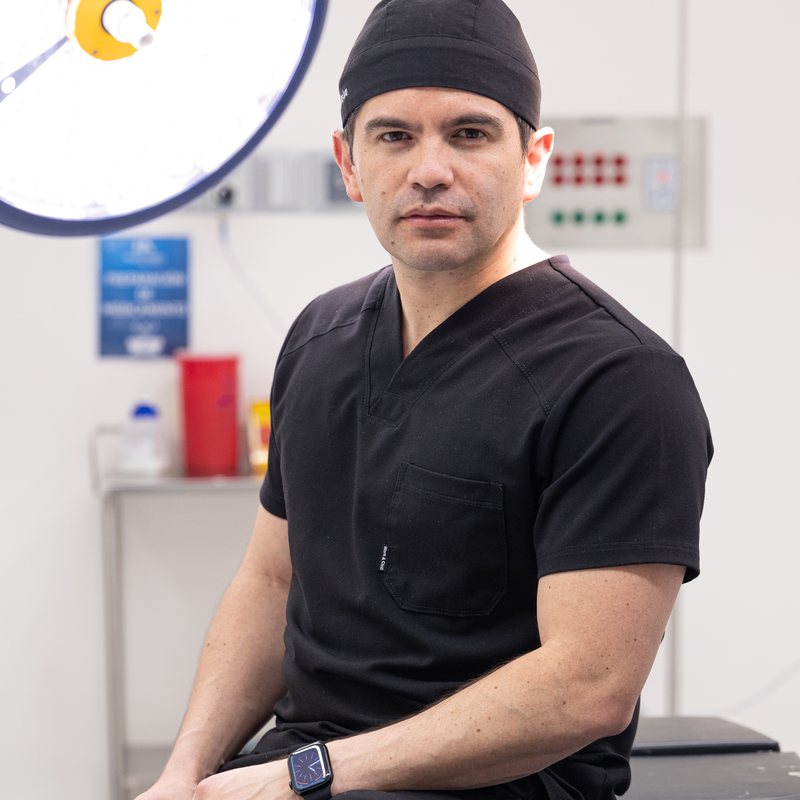
Dr. Luciano Ríos Lara
- Board certified by the Mexican Board of Plastic Surgery
- Trained at UNAM and Hospital General de México
- Teaches plastic surgery residents
Body contouring · CDMX
More shapely, balanced calves you’ll feel confident showing with every step.
Calf implants are silicone implants placed in the calf area to add volume and improve the shape of the lower leg. In Mexico City, calf augmentation is performed as an outpatient procedure.

Results
Real patients of Dr. Ríos Lara, published with their consent.
“A real patient testimonial will go here, with a verified name or initials.”
Your safety
Your surgery takes place at Hospital Ángeles Clínica Londres in Roma Norte, Mexico City, under national and international safety protocols. The facility is also cardio-protected.
The doctor provides all the care you need with no additional surgeon's fees. Only extra hospital costs, if any, are covered by you.
Is it for me?
Calf augmentation with implants improves the size and shape of the calf by placing a silicone implant. Calf implants are made of solid silicone and have an elongated shape designed to mimic the natural contour of the muscle.
The incision is usually made in the crease behind the knee, where the scar is easy to hide. Through it, the surgeon creates a pocket, typically beneath the fascia covering the calf muscle, and inserts the implant. Depending on your goals, an implant can be placed on the inner side, the outer side, or both.
It is a relatively short outpatient procedure. Calf implants do not make the muscle stronger; their purpose is to improve the look and balance of the leg's contour.
Calf augmentation is less common than other body contouring procedures, so it is worth choosing a certified plastic surgeon with experience in it. At your consultation, your surgeon looks at your leg length, skin and muscle thickness, and the shape you want, because an implant that is too large can look unnatural or put tension on the tissue. Your circulation and any history of vein problems in your legs are reviewed as well.
Calf implants are typically recommended for people who feel their calves are thin compared with the rest of their body and have not been able to build them with exercise, which is common because calf size depends heavily on genetics. They can also improve symmetry when one leg is thinner than the other, for example after an illness or injury.
Results vary from person to person. The overall goal is a fuller, more balanced calf.
Both men and women choose this procedure. If you are traveling to Mexico City, keep in mind that you will wear a compression wrap for two weeks, and follow your surgeon's advice on preventing blood clots during a long trip home, such as getting up to walk often.
Recovery
You will wear a compression wrap for two weeks after surgery. Some tightness when walking is normal.
Avoid alcohol for at least three weeks after surgery.
Bruising and swelling fade over several weeks. You will need to avoid exercise during that time; your surgeon will tell you when to resume.
Common questions
The surgery takes about 1.5 hours. It is done under general anesthesia, an epidural, or IV sedation with local anesthesia. It is an outpatient procedure, so you go home the same day.
Mild to moderate temporary discomfort is expected, along with swelling and mild bruising. Some tightness when walking is also normal early on.
Recovery takes several weeks. You will wear a compression wrap for two weeks and avoid alcohol for at least three weeks. You will need to avoid exercise while bruising and swelling fade; your surgeon will tell you when to resume.
A short incision is made in the crease behind the knee, where the scar is easy to hide. Through it, the surgeon creates a pocket in the calf area and inserts the implant.
No. Calf implants do not make the muscle stronger; their purpose is to improve the look and balance of the leg's contour. They can also improve symmetry when one leg is thinner than the other.
Possible complications include infection, bleeding, and changes in skin sensation. Capsular contracture can make the calf feel firm, and asymmetry or implant shifting or damage may occur, which can require removal or replacement.
Pricing depends on your case and is confirmed at your consultation. Your surgeon measures your calves, assesses symmetry, and chooses the implant size and shape.
It depends on how your recovery goes and on your follow-up visits. The timing is defined with you at your consultation, along with advice on preventing blood clots during the trip home.
Price
Price range to be confirmed
Your final price depends on your case. You'll get it in writing at your consultation, with everything it includes.
Get my quotePhone: 55 6232 9139
Getting here
Google Maps (opens in a new tab)Waze (opens in a new tab)Apple Maps (opens in a new tab)View location
Your next step