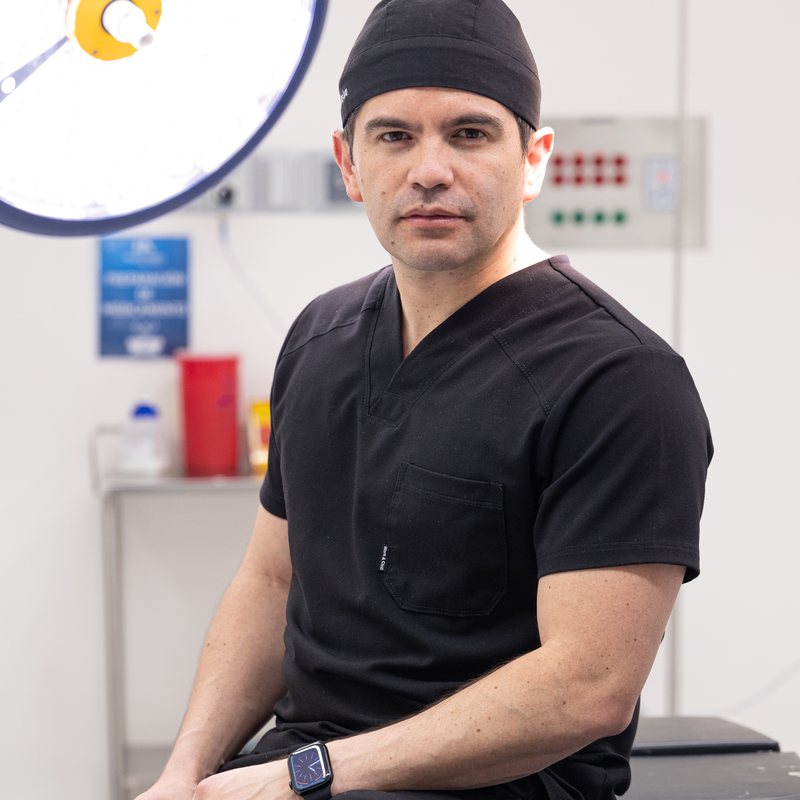
Dr. Luciano Ríos Lara
- Board certified by the Mexican Board of Plastic Surgery
- Trained at UNAM and Hospital General de México
- Teaches plastic surgery residents
Facial and neck surgery · CDMX
Ears in harmony with your face, so you can wear your hair any way you like.
Otoplasty, or ear surgery, corrects protruding ears and can reduce overly large ears by reshaping the cartilage so the ears sit closer to the head. It is performed in Mexico City for children and adults.

Results
Real patients of Dr. Ríos Lara, published with their consent.
“A real patient testimonial will go here, with a verified name or initials.”
Your safety
Your surgery takes place at Hospital Ángeles Clínica Londres in Roma Norte, Mexico City, under national and international safety protocols. The facility is also cardio-protected.
The doctor provides all the care you need with no additional surgeon's fees. Only extra hospital costs, if any, are covered by you.
Is it for me?
Protruding ears usually happen because the cartilage did not form one of its natural folds, or because the bowl of the ear (the concha) is unusually deep. They do not affect hearing, but they can lead to teasing in childhood and self-consciousness later in life.
Otoplasty sets prominent ears back and, when needed, reduces the size of large ears. The cartilage is reshaped with internal sutures that create or reinforce the natural fold, and part of the concha may be reduced. The incision is typically placed behind the ear, in the crease where it meets the head, so the scar stays hidden.
The goal is not to pin the ears flat, but to make them look proportionate and natural from the front and in profile, with both ears as symmetrical as possible.
Because the cartilage is reshaped and secured in its new position, results are generally permanent. In the first few weeks, though, the cartilage is still vulnerable, so the ears need protection with a compression headband and should not be bumped or folded during sleep. Ears are never perfectly identical by nature, so small differences after surgery are normal.
Otoplasty is commonly performed on children once the ear has reached close to its adult size, which usually happens in the early school years. Correcting it at that age can spare a child from teasing. It is also an option for teens and adults who never had their ears corrected. Because adult cartilage is firmer, the technique may be adjusted, but the goal and recovery are similar. Otoplasty can also treat asymmetric ears, where only one ear sticks out.
For children, it matters that they want the surgery and can follow aftercare, including wearing a headband. Families traveling to Mexico City should plan for the first follow-up visit before flying home.
Recovery
A throbbing sensation, pain, swelling, redness or numbness in the ears is normal. The initial dressing stays on.
Most patients can return to school or work within five to seven days.
A special compression headband is worn for four weeks to protect the result.
More strenuous activities, such as contact sports, can resume after one to two months.
Common questions
Surgery takes about 2 hours under anesthesia: usually general for young children, and local with sedation or general for older children and adults. In the first few days, a throbbing sensation, pain, swelling, redness or numbness in the ears is normal.
Recovery takes 1 to 2 months. Most patients can return to school or work within five to seven days, and a compression headband is worn for four weeks. Contact sports can resume after one to two months.
The incision is typically placed behind the ear, in the crease where it meets the head, so the scar stays hidden. Excessive scarring behind the ear is one of the possible risks.
Because the cartilage is reshaped and secured in its new position, results are generally permanent. In the first few weeks, though, the ears need protection with a compression headband and should not be bumped.
Once the ear has reached close to its adult size, which usually happens in the early school years. It matters that the child wants the surgery and can follow aftercare. Otoplasty is also an option for teens and adults.
Expected, temporary effects include throbbing, pain, swelling and numbness. Risks include hematoma, cartilage infection, excessive scarring, asymmetry between the ears and partial return of the protrusion, which may require revision surgery.
Pricing depends on your case and is confirmed at your consultation. At that visit, your surgeon evaluates cartilage shape, how far each ear projects and the symmetry between them.
It depends on how your recovery goes and on your follow-up visits, including the one where the dressing is removed. Your surgeon will define the length of your stay with you at your consultation.
Price
Price range to be confirmed
Your final price depends on your case. You'll get it in writing at your consultation, with everything it includes.
Get my quotePhone: 55 6232 9139
Getting here
Google Maps (opens in a new tab)Waze (opens in a new tab)Apple Maps (opens in a new tab)View location
Your next step